Does the Bitcoin fee depend on the amount? No. Bitcoin network fees depend on the signed transaction’s virtual size and the fee rate selected for that space, not on the value sent.
A small payment can cost more than a large one when it needs many inputs. A large payment can be compact when one suitable input funds it.
Documentation checked: Bitcoin Developer Documentation for transactions and Bitcoin Core’s
fundrawtransactionreference were reviewed on October 30, 2026.
The short answer
| Question | Answer |
|---|---|
| Does the amount set the fee? | No. Virtual size and fee rate are the main inputs |
| Why can a small payment cost more? | It may combine many UTXOs, creating more signed inputs |
| Do more recipients affect the fee? | Yes. Each output adds data |
| Does a wallet choose the fee? | Usually. It estimates a fee rate for a confirmation target |
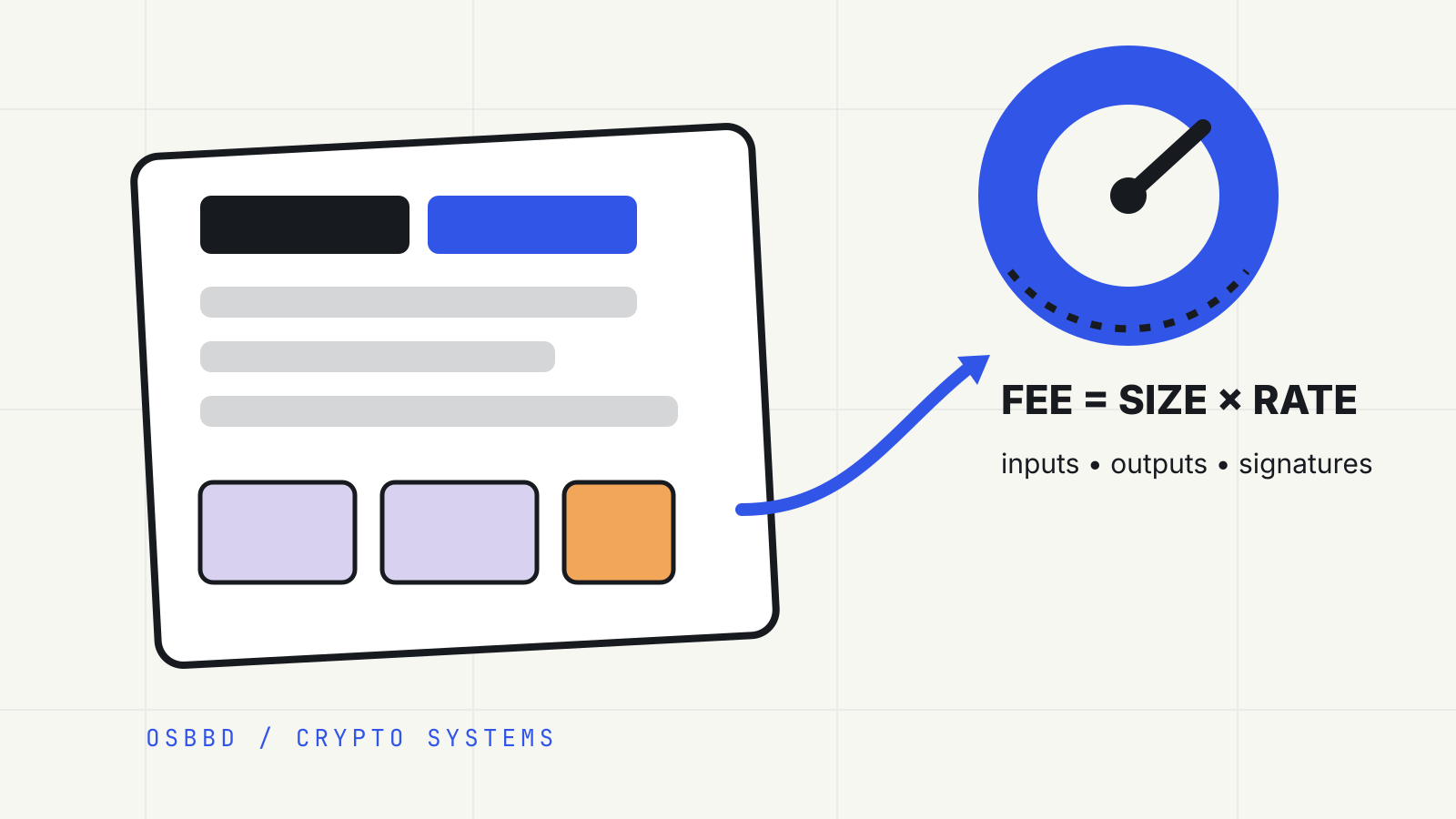
The useful model is fee in satoshis = virtual size in vbytes × fee rate in sat/vB. The dollar value is not part of the formula.
What the network charges for
Bitcoin blocks have limited capacity. A transaction competes for that capacity with other transactions waiting to confirm.
The Bitcoin transaction guide explains that fees are based on the size of the signed transaction. Miners choose which transactions to include, and a transaction offering more fee per unit of space is generally more attractive when blocks are busy.
Wallets normally express the rate as satoshis per virtual byte, or sat/vB. A virtual byte accounts for SegWit witness data through transaction weight. The wallet builds or estimates a transaction, applies a fee rate and may adjust coin selection or change before signing.
Amount and size are separate
A transaction contains references to earlier unspent outputs, unlocking data for those inputs, new outputs and fixed fields. The amount in an output occupies a fixed-size field. Writing a larger number does not make the transaction meaningfully larger.
Consider two payments:
- Wallet A sends 0.001 BTC with one input, one recipient output and one change output.
- Wallet B sends 1 BTC with one input, one recipient output and one change output.
If both use the same script types and fee rate, their virtual sizes can be nearly identical. The larger payment does not take 1,000 times more block space.
The result changes if Wallet A must collect ten small inputs while Wallet B uses one large input. Wallet A’s smaller payment is then larger on the wire and can pay the higher fee.
Inputs often drive the size
Each input identifies a previous transaction output and carries the data needed to authorize spending it. More inputs mean more outpoints, sequence fields and signatures or witness data.
A wallet balance is a set of spendable outputs rather than one account-style number. Our guide to Bitcoin UTXOs, inputs and change explains that structure.
Suppose a wallet needs to pay 120,000 satoshis:
| Coins selected | Input count | Likely effect |
|---|---|---|
| One 150,000-satoshi UTXO | 1 | Compact; usually payment plus change |
| Six 25,000-satoshi UTXOs | 5 or 6 | Larger because each coin becomes an input |
| Many tiny UTXOs | Many | The fee can consume a noticeable share of the payment |
Exact sizes depend on script type. A Taproot or native SegWit input does not have the same weight as a legacy input. The broad relationship remains: more signed inputs normally require more block space.
Outputs add data too
Every recipient becomes an output. A typical payment also creates a change output that returns unused value to the sender.
A transaction paying ten recipients is larger than one paying a single recipient, even when the total value is the same. Batching can still use less space than sending ten separate transactions.
Why wallets show different fees
Wallets may choose different confirmation targets, estimation algorithms, inputs, script types, change policies and safety margins.
Bitcoin Core’s fundrawtransaction reference makes the distinction visible. The wallet can select inputs, add a change output and accept a fee rate in sat/vB. It returns the completed transaction and resulting fee.
One wallet may target the next block. Another may accept several blocks. A third may select different inputs to avoid uneconomical change. Those choices alter the fee while the amount stays the same.
A worked comparison
These sizes are illustrative, not a live quote. Assume 10 sat/vB:
| Transaction shape | Illustrative size | Fee |
|---|---|---|
| 1 input, 2 outputs | 140 vB | 1,400 sat |
| 3 inputs, 2 outputs | 276 vB | 2,760 sat |
| 1 input, 10 outputs | 388 vB | 3,880 sat |
The first transaction could send more bitcoin than the third and still pay less because it uses less space. A production wallet calculates the actual size.
Demand changes the rate
The same transaction can need a different fee rate at different times. When many users want the next blocks, wallets recommend higher rates for short confirmation targets. When demand falls, a lower rate may be enough.
The virtual size does not change because the mempool is busy. The market price for that space changes.
Ways to avoid unnecessary cost
You cannot remove the cost of block space, but you can sometimes avoid unnecessary size or urgency:
- choose a longer confirmation target when the payment is not urgent;
- use a wallet with modern address types;
- batch planned payments where appropriate;
- avoid repeatedly creating tiny UTXOs;
- consolidate small UTXOs when rates are low, while considering privacy;
- inspect the transaction preview before signing.
Consolidation itself costs a fee and can link coins that were previously separate. It is a cost, timing and privacy decision.
Why a fee percentage can mislead
An interface may display the network fee as a percentage of the payment. That ratio can help judge whether a payment is economical, but the protocol does not calculate fees that way.
The same 2,000-satoshi fee is 2% of a 100,000-satoshi payment and 0.02% of a 10,000,000-satoshi payment. The underlying transaction can be identical in size.
A service may also add a withdrawal charge separate from the network fee. Check whether the interface labels the amount as network fee, service fee or total deduction.